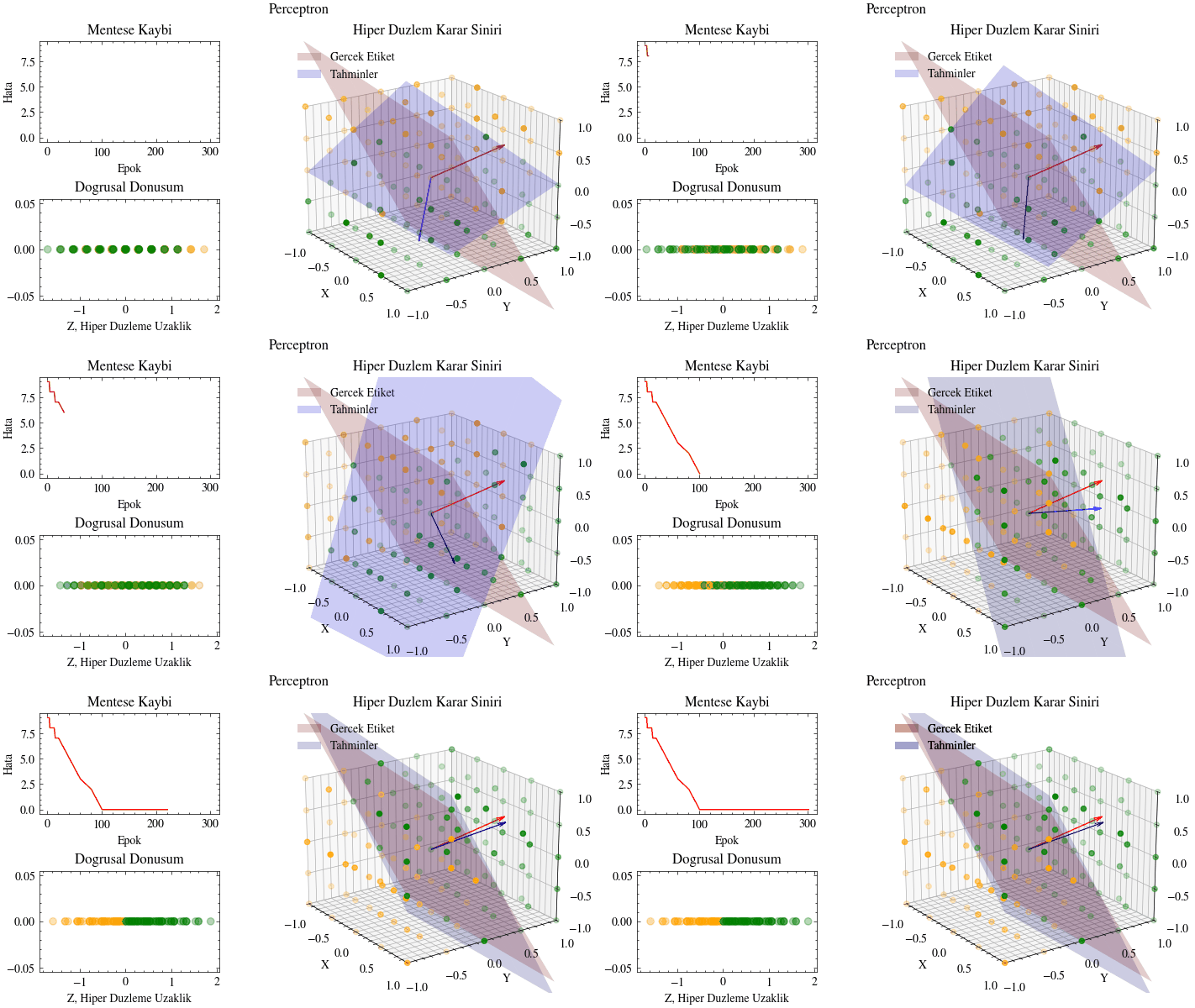
Perceptron#
Perceptron algoritması, iki sınıfı ayıran bir hiperdüzlem için en uygun ağırlıkları bulur. Bu problem ikili sınıflandırma olarak da bilinir.
Kitaplıkları içe aktaralım.
import numpy as np

# %matplotlib inline
import matplotlib.pyplot as plt
from mpl_toolkits.mplot3d import Axes3D

from celluloid import Camera
import scienceplots
from IPython.display import Image

np.random.seed(0)
plt.style.use(["science", "no-latex"])
Eğitim Veri Kümesi#
Etiketin doğrusal bir karar sınırıyla belirlendiği bir veri kümesi oluşturalım. Perceptron’umuz, bu veri kümesini iki sınıfa ayıracak normal vektörün ağırlıklarını öğrenecek.
def generate_dataset(dims, normal_vector):
    # create 3D grid of points
    points = np.linspace(-1, 1, dims)
    X, Y, Z = np.meshgrid(points, points, points)

    # features are the x, y, z coordinates
    features = np.column_stack((X.ravel(), Y.ravel(), Z.ravel()))

    # labels are the side each point is on the hyperplane
    distances = np.dot(features, normal_vector)
    labels = np.where(distances >= 0, 1, -1)
    return X, Y, Z, features, labels

# normalized normal vector
target_normal_vector = np.array([1.0, 1.0, 1.0])
target_normal_vector = target_normal_vector / np.linalg.norm(target_normal_vector)

scaling = 5
X, Y, Z, features, labels = generate_dataset(scaling, target_normal_vector)

fig = plt.figure()
ax = fig.add_subplot(111, projection="3d")

# plot the points
ax.scatter(features[:,0], features[:,1], features[:,2], marker='o', alpha=0.3, c=labels)
<mpl_toolkits.mplot3d.art3d.Path3DCollection at 0x10b154950>
Hiperdüzlem#
Hiperdüzlem, bulunduğu uzaydan bir boyut daha düşük olan düz bir alt uzaydır. Bir veri kümesini doğrusal olarak ayırmak için kullanılabilir. Bir hiperdüzlemin denklemi, ona dik olan \(\vec{w}\) normal vektörüyle tanımlanır.
\( \begin{align*} \vec{w} \cdot \vec{x} = w_1 x_1 + ... + w_n x_n = 0 \end{align*} \)
Bizim örneğimizde \(\vec{x}\), x, y, z koordinatlarını ifade eder.
\( \begin{align*} \vec{w} \cdot \vec{x} &= 0 \\ &= w_1 x + w_2 y + w_3 z \end{align*} \)
İkili sınıflandırma yaparken bir noktanın hiperdüzlemin hangi tarafında kaldığını kullanmak istediğimiz için, z değeri tahmin ettiğimiz etiket olabilir.
\( \begin{align*} z = -(w_1 x + w_2 y) / w_3 \end{align*} \)
def generate_hyperplane(scaling, normal_vector):
    # create 2D points
    points = np.linspace(-1, 1, scaling)
    xx, yy = np.meshgrid(points, points)

    # the z value is the defined by the hyperplane
    zz = -(normal_vector[0] * xx + normal_vector[1] * yy) / normal_vector[2]
    return xx, yy, zz

xx, yy, zz = generate_hyperplane(scaling, target_normal_vector)

# visualize the hyperplane
fig = plt.figure()
ax = fig.add_subplot(111, projection="3d")

# plot the hiper düzlem defined by the normal vector
ax.plot_surface(xx, yy, zz, alpha=0.2, color="gray")
ax.quiver(
    0,
    0,
    0,
    target_normal_vector[0],
    target_normal_vector[1],
    target_normal_vector[2],
    color="green",
    length=1,
    arrow_length_ratio=0.2,
)

ax.set_xlabel("X")
ax.set_ylabel("Y")
ax.set_zlabel("Z")
ax.set_title("Hiper Düzlem")
Text(0.5, 0.92, 'Hiper Düzlem')
Kayıp Fonksiyonu: Menteşe Kaybı#
Kayıp fonksiyonları, bir tahminin hatasını sayısallaştırmak için kullanılır.
Perceptron, doğru sınıflandırılan örneklerde 0; yanlış sınıflandırılan ya da sınırda kalan örneklerde ise pozitif bir değer üreten menteşe kaybını kullanır.
\( \begin{align*} L(\vec{w}, b) = max(0, -y(\vec{w} \cdot \vec{x} + b)) \end{align*} \)
def hinge_loss(w, x, b, y):
    return max(0.0, -y * (np.dot(w, x) + b))
Menteşe Kaybının Gradyanı#
Parametreleri gradyan inişiyle güncelleyebilmek için, kaybın \(W\) ve \(b\)’ye göre türevlerini bulmamız gerekir.
Menteşe Kaybının \(B\) Cinsinden Türevi#
Kayıp fonksiyonunun \(b\)’ye göre türevi:
\( \frac{\partial L}{\partial b} = \begin{cases} 0 & -y(\vec{w} \cdot \vec{x} + b) > 1 \\ -y & \text{aksi halde} \end{cases} \)
def hinge_loss_db(w, x, b, y):
    if y * (np.dot(w, x) + b) <= 0.0:
        return -y
    return 0
Menteşe Kaybının \(W\) Cinsinden Türevi#
Kayıp fonksiyonunun \(\vec{w}\)’ye göre türevi:
\( \nabla_{W} [L(\vec{w}, b)] = \begin{cases} 0 & -y(\vec{w} \cdot \vec{x} + b) > 1 \\ -y x & \text{aksi halde} \end{cases} \)
def hinge_loss_dw(w, x, b, y):
    if y * (np.dot(w, x) + b) <= 0.0:
        return -y * x
    return np.zeros_like(x)
Grafik Fonksiyonları#
Görselleştirmeleri üretmek için yardımcı fonksiyonlar.
def create_plots():
    fig, ax = plt.subplots(2, 3, figsize=(16 / 9.0 * 4, 4 * 1), layout="constrained")
    fig.suptitle("Perceptron")

    ax[0, 0].set_xlabel("Epok", fontweight="normal")
    ax[0, 0].set_ylabel("Hata", fontweight="normal")
    ax[0, 0].set_title("Menteşe Kaybı")

    ax[1, 0].set_xlabel("Z, Hiper Düzleme Uzaklık", fontweight="normal")
    ax[1, 0].set_ylabel("", fontweight="normal")
    ax[1, 0].set_title("Doğrusal Dönüşüm")

    ax[0, 1].axis("off")
    ax[0, 2].axis("off")
    ax[1, 1].axis("off")
    ax[1, 2].axis("off")

    ax[1, 2] = fig.add_subplot(1, 2, 2, projection="3d")
    ax[1, 2].set_xlabel("X")
    ax[1, 2].set_ylabel("Y")
    ax[1, 2].set_zlabel("Z")
    ax[1, 2].set_title("Hiper Düzlem Karar Sınırı")
    ax[1, 2].view_init(20, -35)
    ax[1, 2].set_xlim(-1, 1)
    ax[1, 2].set_ylim(-1, 1)
    ax[1, 2].set_zlim(-1, 1)

    camera = Camera(fig)
    return ax[0, 0], ax[1, 0], ax[1, 2], camera


def plot_graphs(
    ax0,
    ax1,
    ax2,
    idx,
    visible_err,
    err_idx,
    errors,
    scaling,
    target_normal_vector,
    predictions,
    features,
    labels,
    weights,
):
    ax0.plot(
        err_idx[visible_err][: idx + 1],
        errors[visible_err][: idx + 1],
        color="red",
    )

    # Ground truth
    xx_target, yy_target, zz_target = generate_hyperplane(scaling, target_normal_vector)
    ground_truth_legend = ax2.plot_surface(
        xx_target,
        yy_target,
        zz_target,
        color="red",
        alpha=0.2,
        label="Gerçek Etiket",
    )
    ax2.quiver(
        0,
        0,
        0,
        target_normal_vector[0],
        target_normal_vector[1],
        target_normal_vector[2],
        color="red",
        length=1,
        arrow_length_ratio=0.1,
    )

    # Perceptron predictions using 2D graph to show linear transformation
    def generate_colors(arr):
        return ["green" if d >= 0 else "orange" for d in arr]

    ground_truth_colors = generate_colors(labels)
    ax1.scatter(
        predictions,
        np.zeros(predictions.shape),
        c=ground_truth_colors,
        marker="o",
        alpha=0.3,
    )

    # Perceptron predictions using 3D graph to show hyperplane
    predictions_colors = generate_colors(predictions)
    predictions_norm = np.maximum(1 - np.exp(-(predictions**2)), 0.2)

    ax2.scatter(
        features[:, 0],
        features[:, 1],
        features[:, 2],
        c=predictions_colors,
        marker="o",
        alpha=predictions_norm,
    )

    xx, yy, zz = generate_hyperplane(scaling, weights)
    predictions_legend = ax2.plot_surface(
        xx,
        yy,
        zz,
        color="blue",
        alpha=0.2,
        label="Tahmin",
    )
    ax2.quiver(
        0,
        0,
        0,
        weights[0],
        weights[1],
        weights[2],
        color="blue",
        length=1,
        arrow_length_ratio=0.1,
    )

    # Legend
    ax2.legend(
        (ground_truth_legend, predictions_legend),
        ("Gerçek Etiket", "Tahminler"),
        loc="upper left",
    )
Gradyan İnişi#
Ağırlıkları ve bias terimini güncellemek için gradyan inişini kullanacağız.
Bias terimi için gradyan inişi:
\( \begin{align*} b &= b - \eta \frac{\partial}{\partial b} [L(\vec{w}, b)] \\ &= b - \eta \begin{cases} 0 & -y(\vec{w} \cdot \vec{x} + b) > 1 \\ -y & \text{aksi halde} \end{cases} \end{align*} \)
Ağırlıklar için gradyan inişi:
\( \begin{align*} \vec{w} &= \vec{w} - \eta \nabla_{W} [L(\vec{w}, b)] \\ &= \vec{w} - \eta \begin{cases} 0 & -y(\vec{w} \cdot \vec{x} + b) > 1 \\ -y x & \text{aksi halde} \end{cases} \end{align*} \)
def gradient_descent(weights, x, bias, y, learning_rate):
    weights = weights - learning_rate * hinge_loss_dw(weights, x, bias, y)
    bias = bias - learning_rate * hinge_loss_db(weights, x, bias, y)

    return weights, bias
Modeli Eğitmek#
def fit(
    weights,
    bias,
    target_normal_vector,
    features,
    labels,
    X,
    Y,
    Z,
    scaling,
    epochs,
    learning_rate,
    optimizer,
    output_filename,
):
    err_idx = np.arange(1, epochs + 1)
    errors = np.full(epochs, -1)
    ax0, ax1, ax2, camera = create_plots()

    for idx in range(epochs):
        error = 0
        predictions = np.array([])

        for x, y in zip(features, labels):
            # Forward Propagation
            output = np.dot(weights, x) + bias

            predictions = np.append(predictions, output)

            # Store Hata
            error += hinge_loss(weights, x, bias, y)

            # Gradyan İnişi
            weights, bias = optimizer(weights, x, bias, y, learning_rate)

        error /= len(X)
        weights = weights / np.linalg.norm(weights)

        if (
            idx < 5
            or (idx < 15 and idx % 2 == 0)
            or (idx <= 50 and idx % 10 == 0)
            or (idx <= 1000 and idx % 20 == 0)
            or idx % 250 == 0
        ):

            print(f"epok: {idx}, MSE: {error}")

            # Plot MSE
            errors[idx] = error
            visible_err = errors != -1

            plot_graphs(
                ax0,
                ax1,
                ax2,
                idx,
                visible_err,
                err_idx,
                errors,
                scaling,
                target_normal_vector,
                predictions,
                features,
                labels,
                weights,
            )

            camera.snap()

    animation = camera.animate()
    animation.save(output_filename, writer="pillow")
    plt.show()
Şimdi her şeyi bir araya getirip Perceptron modelimizi eğitelim.
weights = np.array([1.0, -1.0, -1.0])
weights = weights / np.linalg.norm(weights)

bias = 0
epochs = 301
learning_rate = 0.0005

output_filename = "perceptron.gif"
fit(
    weights,
    bias,
    target_normal_vector,
    features,
    labels,
    X,
    Y,
    Z,
    scaling,
    epochs,
    learning_rate,
    gradient_descent,
    output_filename,
)
epok: 0, MSE: 9.314269414709884
epok: 1, MSE: 9.227024830601328
epok: 2, MSE: 9.145087443313994
epok: 3, MSE: 9.054781136556876
epok: 4, MSE: 8.960407022428585
epok: 6, MSE: 8.758853058777223
epok: 8, MSE: 8.53921460232333
epok: 10, MSE: 8.301374396907338
epok: 12, MSE: 8.08268967439665
epok: 14, MSE: 7.848010649913292
epok: 20, MSE: 7.2399656649458395
epok: 30, MSE: 6.264254344109916
epok: 40, MSE: 5.307156953825982
epok: 50, MSE: 4.404348110031334
epok: 60, MSE: 3.583744302061389
epok: 80, MSE: 2.0340687540122784
epok: 100, MSE: 0.9393759997635176
epok: 120, MSE: 0.3544588382632633
epok: 140, MSE: 0.12744345824321832
epok: 160, MSE: 0.018715050957434115
epok: 180, MSE: 0.0
epok: 200, MSE: 0.0
epok: 220, MSE: 0.0
epok: 240, MSE: 0.0
epok: 250, MSE: 0.0
epok: 260, MSE: 0.0
epok: 280, MSE: 0.0
epok: 300, MSE: 0.0
/var/folders/x3/xmq8mst51mjb124_9bh98jy80000gn/T/ipykernel_57426/2015002447.py:73: UserWarning: FigureCanvasAgg is non-interactive, and thus cannot be shown
  plt.show()
Çıktı Animasyonu#
Image(filename=output_filename)